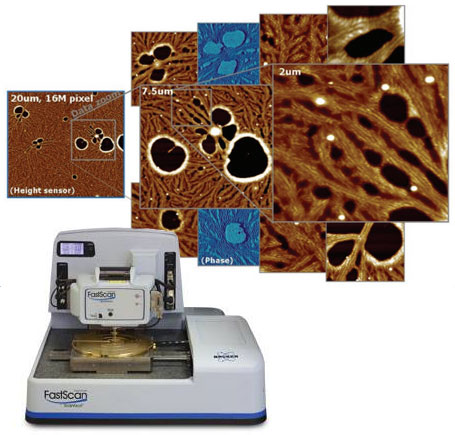
Bruker’s Nanomechanics Lab is a new package with AFM modes for nanoscale characterisation of a wide range of materials, including hydrogels, metals and ceramics. The package is compatible with the Bruker Dimension Icon and Dimension FastScan AFM systems.
Characterise a Wide Range of Materials
Bruker’s NanoMechanics Lab is a new package for quantifiable nanoscale characterisation. The package is comprehensive, combining multiple techniques for a wide range of materials. Acquire accurate and reliable AFM mechanical property data about all kinds of challenging materials, including soft hydrogels, stiff metals and ceramics.
Access a full range of advanced modes with precise force and frequency control for complete nanomechanics materials research, from sub-nanometer resolution investigation to high volume AFM measurement and data analysis.
Nanomechanics Lab is compatible with Bruker Dimension Icon and Dimension FastScan AFM systems.

Nanomechanical Characterisation Techniques
NanoMechanics Lab gives you access to Bruker’s most advanced nanoscale AFM measurement techniques and modes, including:
- Force Volume
- PeakForce QNM
- New FASTForce Volume
- New FASTForce Volume Contact Resonance
These modes can be combined to create large data cubes, yielding a full array of elastic and viscoelastic data with high precision and repeatability from a single AFM system.
Features
- Quantify materials’ mechanical properties from hydrogels to metals
- Viscoelastic and rheological properties
- Routinely obtain data correlating to traceable nanoindentation and bulk DMA
- Switch easily between techniques using the software
- Unique, individually pre-calibrated probes with controlled geometry to reduce errors and uncertainty
- New models for accurate data fitting

New Capabilities
PeakForce QNM (Quantitative Nanomechanical Mapping)
With a new, improved version of PeakForce QNM, you can quantitatively characterise nanomechanical properties including modulus, adhesion, dissipation and deformation – while simultaneously imaging sample topography at atomic scale resolution.
The method is non-destructive to both the tip and the sample; the peak normal force is controlled, and the lateral force on the probe is kept to a minimum.
Perform routine quantifiable mechanical studies of materials in the 1 kPa to 100 GPa range.
Bruker’s new vibrometry-calibrated AFM probes feature a precise tip shape for greater accuracy and consistently repeatable modulus measurements. When used with PeakForce QNM, you can take routine measurements with much greater certainty and render your results with high-resolution nanoscale mapping.
Webinar slides: Improved Accuracy AFM Nanomechanical Measurements

FASTForce Volume
FASTForce Volume accelerates the acquisition time of Force Mapping by >20x. Measure the mechanical properties of materials in the range of 1 kPa to 100 GPa.
Linear ramps can be applied with frequencies up to 400 Hz to overlap with QNM for nanomechanical correlative studies between modes. This gives you greater measurement confidence and enables analysis of the frequency dependency of mechanical properties.

FASTForce Volume CR
FASTFORCE Volume CR is an enhanced AFM Contact Resonance technique. Measure a wide range of moduli, including both elastic and viscoelastic properties, even for stiff materials (<1 GPa to >300 GPa), including:
- Storage modulus
- Loss modulus
- Contact stiffness
- Loss tangent
Use AC force mapping to capture the full force-distance curve and sweep the entire frequency spectrum at each image pixel. This improves modelling for repeatable and traceable results. Capture more than 15 different mechanical data channels, including adhesion and stiffness, with real-time displays of mechanical property values.

Overcoming the Limitations of Contact Resonance
Contact resonance has previously been hampered by slow imaging speeds, complex analysis, and the need for specialised hardware for full-spectrum acquisition.
FASTForce Volume CR overcomes these limitations by combining resonant and non-resonant modes to obtain the most accurate mechanical data, together with flexible, easy-to-use software. In contrast to other imaging-based contact resonance methods that are essentially contact mode, FASTForce Volume CR minimises lateral forces on the tip to reduce sample damage and tip wear, and to gather multiple measurements from a single probe.
3 More Nanomechanical Capabilities You May Not Be Aware of
- Stress and Strain Relaxation can be quantified at every image pixel with the new Ramp Scripting software.
- Frequency swept as a function of contact force to study frequency-dependent stiffness and viscoelastic response.
- FastForce Volume – Simultaneous electrical modes (PFM, MFM, etc.) to generate datasets of information that were previously unobtainable.
Further Information
If you have any questions or if you’d like a demonstration or quote for Nanomechanics Lab for a new or existing AFM, please get in touch. Blue Scientific is the official distributor of Bruker AFM in the Nordic region, and we’re available regionally to help with any queries you have.
Contact us on +44 (0)1223 422 269 or info@blue-scientific.com